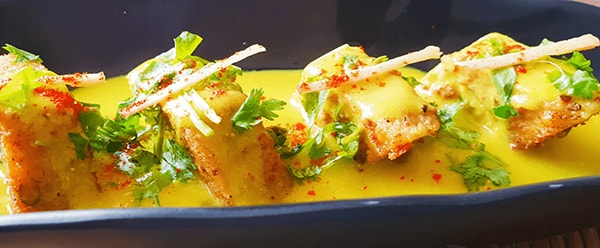
Indrahar ( Steamed and fried lentils cake)

Ingredients:

1/2 cup of Red Gram (Arhar Dal or Tuvar Dal)

1/2 cup of Green Lentil (Moong dal – husked)

1/2 cup of Black Lentil ( Urad Dal -Husked)

1/2 cup of Red Lentil (spilt and Husked

2 tblsp of coriander, green chilli and garlic minced

1 cup cooking oil (for tempering + grease the plate for steaming + frying the steamed cakes

¼ Tbsp. of cumin seeds

¼ Tbsp. of Turmeric powder

2 whole red chillies broken half

Salt to taste

Ingredients: for the Kadhi

1.5 cups of thick curd

2 gram flour

1 cup of Water

½ Tbsp. cooking oil

¼ Tbsp. mustard seeds

¼ Tbsp. cumin seeds

½ Tbsp. ginger garlic paste

1/8 Tbsp. asafoetida

Salt to taste

Method to make the Steamed Cakes or Indrahaar

Wash all the dals and soak them together for overnight

Drain the water, grind them with few tablespoons of water in a mixer grinder until the paste is smooth and creamy.

Heat a kadhai or non-stick pan, add oil, jeera and whole red chillies.

Now, add the ground dal paste followed by turmeric powder and the minced coriander, garlic and green chillies.

Add salt to taste and mix everytasafoetida together on low heat until the mixture start leaving the oil from the sides.

Grease a plate with a tsp of oil.

Switch off the flame, add this mixture to the steamer plate and spread evenly and steam this for 20 minutes.

Allow it to cool completely before slicing into pieces.

Pan fry them in the oil until the crust is brown in colour. Remove the pieces aside, serve as snack or prepare the kadhi as explained below.

Method to make the Kadhi:

Whisk the curd well to avoid lumps.

Mix besan (Gram flour) and few tblsp of water and whisk this mixture well to avoid lumps.

Now, mix the curd and the besan + water mixture and whisk again.

Heat a kadhai or non-stick pan, add oil

Now add the mustard seeds and allow it to crackle, followed by cumin seeds and asafetida.

Add the ginger and garlic paste, saute well for few seconds until the raw smell is off.

Add the curd + besan mixture and simmer this on low heat.

Allow it to reach one boil, add water as desired to adjust the consistency.

Add salt and once the kadhi mixture starts simmering and turns thick and glossy, switch off the flame. Serve this kadhi over the indrahar .
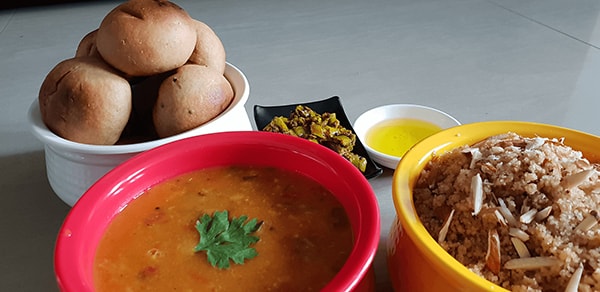

Dal Bati (Wheat Cakes/balls and Lentils Combo)

Ingredients:

For Dal:

50 gm channa dal (Bengal gram)

50 gm masoor dal (Red lentils, split)

50 gm toor dal (Yellow lentils, pigeon peas, red gram )

50 gm moong dal (Green lentil, husked)

50 gm urad dal (Black Lentil husked)

(The above lentils should be soaked for at least 30 minutes)

1-1/2 Tbsp. ghee/clarified butter

½ Tbsp.cumin seeds

1/2cup onions

2 tsp ginger paste

1 tsp garlic paste

2 tsp coriander powder

1 tsp red chili powder

1 tsp turmeric powder

2 Tbsp. coriander Chopped

salt to taste

The Tempering:

1 Tbsp. ghee/clarified butter

a generous pinch of asafoetida 1 tsp cumin seeds

The Bati:

2 cups atta/whole-wheat flour

1/2 tsp baking powder

1 cup water

salt to taste

1 cup ghee/clarified butter to soak batti

Method:

Sift flour, baking powder and salt into a tray, add melted ghee and start mixing gradually. Add water and knead to obtain the dough. Divide into 20 equal portions, make balls, cover with moist cloth and rest it for 10 minutes. Now flatten the balls to make patties. Dust a baking tray with flour, arrange these on it, cover with moist cloth and rest until ready to bake. Uncover the baati patties after 30 minutes and put the baking tray in the pre-heated oven ,bake for 30-35 minutes on 180 ºC°C.

To prepare the dal, heat ghee in a, add cumin, stir over medium heat until it begins to splutter, add onions and stir until light golden. Add the ginger and garlic pastes, stir until onions are golden. Add coriander, red chili and turmeric powders -dissolved in 2 Tbsp. of water-and stir-fry until the moisture evaporates. Now add 3 cups of water, add the lentils and salt, stir, bring to a boil, reduce to low heat and simmer until cooked (approx 25-30 minutes).

To prepare the tempering, heat ghee in a frying pan; add asafoetida, stir over medium heat for a few seconds, add cumin and wait for the seeds to splutter. Remove, pour over the dal, stir, remove and adjust the seasoning. Sprinkle fresh coriander.

Remove the baati from the oven, press the top to crack open the crust and soak in melted ghee (to soak baati). Serve with dal and churma.

Embracing the Goodness of Greens

I am a vegetarian; travelling across India and other parts of the world and witnessing the spread of vegetarianism all-over has led me to appreciate and value the aspects of it. Today, even in meat-dominated countries, finding a good vegetarian meal is not difficult. Countries across the world, boast many vegetarian and vegan-friendly restaurants owing to a growing number of people who are willing to adopt a vegetarian lifestyle.

Following a vegetarian diet is no longer akin to just eating salads and fruits – with time and migration of people, food cultures are no longer rigid or sterile. Countries and people have embraced each other’s eating habits and lifestyle.

Pull through the narrow city by lanes, or stop by spacious yet busy highway eateries in India, everywhere in the country, you will be welcomed by iconic vegetarian roadside stalls, restaurants or dhabas.Not only eateries but even as we go from one convenience store to another, super foods, plant-based milk and yogurt, mock meat products, and fresh produce on the shelves give a tough competition to their non-vegetarian neighbours.

India is known as a vegetarian country even though non-vegetarians outnumber their vegetarian counterparts here. Shifting (or not) to a vegetarian lifestyle is an individual’s choice, but of late,as consumers around the world become more mindful of what they consume and broaden their search for healthier foods, they are concocting healthier meals, while making sure it is respectful of nature and of animal well-being.

At Spoon&Hand, we support good health and sustainability, and are passionate about making a vegetarian lifestyle more easily adopted by providing recipes and ideas for healthy and easily accessible vegetarian meals. Whether you have decided to embrace vegetarianism, or just looking for new vegetarian alternatives for your meatless days, we try to keep you motivated and inspired with fresh recipes.

Winter Savouries from the Mountains

Food Travel in Himachal Pradesh:

Upon setting foot in Shoghi, a little Suburb in Shimla (Himachal Pradesh), a thick blanket of trees surrounded me. It was an early January morning and colourful houses nestled amongst the hills were still covered in deep mist, even though the sun had shone its first rays.

I was observing this view from the window of one of those houses on the hills. In this tiny suburb, I chose to stay at a village homestay, to make my cooking experience more local and authentic.

Himachal Pradesh is a cold place year-round. All I could see around me were mountains and forests that make up most of the ground in the state; and then I observed that lifestyle of the people here is of course altered to the colds – be it warm clothes, or their warm dishes to keep one cozy during winters.

I noticed that most households there have grown their own vegetables and spices around their houses. That’s the reason why the ground in and around the village is full of plants with spices and lentils like red chili and red beans.

To start the day, my host (owner of the house), lit up the angeethi. Angeethi is a traditional stove made of mud that is used for cooking with coals. We started off to prepare one of the primary winter dishes in the hills – Sidu Bread. One of the villagers told me that though Sidu Bread can be consumed throughout the year, in Shoghi (and of course other areas in the state), it is especially savoured during special occasions, festivals and in winters to keep the body warm.

The main ingredients of the dish are fermented bread, ghee (clarified butter) and spices; and making it is short and easy. First, we knead soft dough adding dried yeast and warm water in plain flour. For the filling, we used ghee, onions, khus khus (poppy seeds) and spices like cumin and coriander powder. The stuffed balls are then put on direct flame and then steamed.

My host told me that though she prefers stuffing the bread with only these fillings, people also fill dry fruits and/or pulses right in the middle.

The best part about these bread balls is that they are dunked in ghee before being eaten, and are usually accompanied with rice, gur (jaggery) and ghee (clarified butter), which are traditionally consumed in hilly Indian villages before a meal.

Don’t worry, this dish is heavy but easy to digest”, jokingly said a member of the family as I sat down to eat. Indeed, the dish might be made with ample of ingredients, but poppy seeds and jaggery help to easily digest it.

The one thing I observed about the cooking style in this part of the Indian hills is that most dishes have a dominant sweet or sweet-sour taste (made sweet with using jaggery and/or tamarind), which are used intensively in local food preparations.

We enjoyed our first meal in the village sitting on the grass, outside the house, with the views of mountains around us. Though the ingredients were not very different from those we use while cooking in our urban houses, the angeethi and home-grown spices gave the dish a refreshing and unique taste.

Where cooking is passion, not a profession

It might seem out of place for an outsider, but for me as an Indian,eating with my hands, without the use of any fancy cutlery, is an everyday affair. Be it a dish like humble Dal-Chawal (lentil and rice) from north India, or any of the South Indian staple, travel to any part of the country and you will see a majority of people eating with their hands. After all, it is not for nothing that the phrase “Jab tak hath se nahi khaoge santushti nahi hogi” (for contentment, you must eat with your hands) is often used in Indian households. And why not, when you use your hands to eat, you become conscious of the texture, flavour and taste of your meal.For those of you who might think it is unhygienic, wash your hands well and indulge into your plate.

Through Spoon&Hand, my outlook is to share with you more food-related stories and perspectives like these, and to take you through a journey where hands and spoons meet, to create a magic of warmth of food. Being born and raised in a vegetarian family, my choice of food is vegetarian, and so my food journal at Spoon&Hand is also going to be strictly vegetarian.However, I will take onion-garlic and dairy products along the way in this journey.

Through this site, I set out to share my passion for cooking through vegetarian home cooking. The recipes lean towards comfort food, which are a combination of many old Indian family recipes and cooking styles borrowed from various cultures across the world. Here, you will find ideas for home-style dishes and building meals around ingredients that are in season. Apart from recipes, take a virtual food tour across cultures. You can share your recipes and your cooking ideas. My simple aim to bring home cooking to a level where not only it tastes great but looks great too.

Happy cooking!